In the city of Marysville in Yuba County, California, Blue Zones Project Yuba-Sutter empowered two students to turn their vision of a community refrigerator for those facing food insecurity into a reality.
Blue Zones Project Yuba-Sutter empowered two students to turn their vision of a community refrigerator for those facing food insecurity into a reality. Share on XA ribbon-cutting ceremony for the new community refrigerator was held in March, following close to a year of work on the project. Plans are already in place to expand the program in the future.
Marni Sanders, Executive Director of Blue Zones Project Yuba-Sutter, was instrumental in bringing community partners together to support the project, conceived by local eighth-graders, Mia Bumpus and Addalie Burns.
Marni Sanders, Executive Director of Blue Zones Project Yuba-Sutter, was instrumental in bringing community partners together to support the project, conceived by local eighth-graders, Mia Bumpus and Addalie Burns. Share on X“Blue Zones Project has been a partner with [the students] through all this, just really helping to leverage our connections to support them to make this happen. We organized the ribbon cutting, and we got the media attention to come and highlight their work,” she said.
The refrigerator was placed in the Habitat for Humanity Yuba-Sutter building, which houses a Restore used furniture shop in the front, and offices for comprehensive housing and community services in the back. For example, the Supportive Outreach Department offers everything from housing services for those experiencing homelessness to transportation and a substance abuse treatment program.
The refrigerator was placed in the Habitat for Humanity Yuba-Sutter building, which houses a Restore used furniture shop in the front, and offices for comprehensive housing and community services in the back. Share on X“The refrigerator was placed perfectly in a location where people from the community that are being served through Habitat for Humanity–people at a disadvantage who often are experiencing food insecurity–are being served. We were very strategic and deliberate about that placement because we knew it would serve a community in need. And from what I understand, the food is flying off the shelves there, and it’s hard to keep it stocked, so it is definitely serving the community,” said Sanders.
John Nicoletti, COO of Habitat for Humanity Yuba-Sutter, which donated the refrigerator, said, “We are seeing the fridge fill and flow back out every day.” For example, he said a woman named Shawna, who recently came into services, was ecstatic when she was able to take food home to prepare a spaghetti dinner and have a proper celebration that night.
Blue Zones Project Helps Eighth-Graders Make Community Refrigerator a Reality Share on X“Food that’s placed there is fresh, healthy food,” said Sanders. “There’s a lot of healthy produce, and that’s our desire at Blue Zones Project – that we close that gap for people to access healthy, fresh foods. This is just one way we were able to come alongside community partners and help address that need.”
“There’s a lot of healthy produce, and that's our desire at Blue Zones Project – that we close that gap for people to access healthy, fresh foods. This is just one way we were able to come alongside community partners and help address… Share on X
What are community refrigerators?
The concept of community refrigerators originated in Germany, and the first community refrigerator in the U.S. was reportedly opened in 2014 in California. Since then, community refrigerators have grown in popularity, primarily through grassroots efforts in cities such as Atlanta, Chicago, New York City, and Richmond, Virginia.
Community refrigerators are placed in public spaces, often accessible 24/7, to provide free food for anyone who needs it. Local businesses, organizations, or individuals stock the fridges with fresh produce, prepared meals, and non-perishables. In addition to addressing food insecurity, community refrigerators also help to prevent food waste by providing a place to donate surplus food that might otherwise be discarded.

Food waste is so prevalent that some states have even implemented laws to reduce it. In California, for example, Senate Bill 1383 requires restaurants and other businesses to divert edible food from landfills by donating it to food recovery organizations for distribution to those in need.
The Yuba Sutter community refrigerator is open to everyone. “It’s for families. It’s for the homeless. It’s for anyone. It’s not really designed to be one-stop, get all my groceries, but it’s an open, free refrigerator, and it’s based on the honor system,” said Sanders.
“It's for families. It's for the homeless. It's for anyone. It's not really designed to be one-stop, get all my groceries, but it’s an open, free refrigerator, and it’s based on the honor system.” -Marni Sanders Share on XTurning two students’ visions into a reality

Addalie Burns got the idea to bring a community refrigerator to Yuba-Sutter after she saw people using them while on a trip to New York City. She became curious about what they were and began doing research. She thought it would be great to have a community refrigerator in her own community and shared her idea with her friend Mia Bumpus. Then both girls got their mothers, Christie Burns and Stephanie Bumpus, involved.
Addalie’s mother contacted Blue Zones Project, which has been working in the community for three-and-a-half years, and Sanders met with the girls and their moms about a year ago. “I loved what they were saying,” Sanders recalls. “It really aligned with our food policy work that we are working on here in our community.”
From there, Sanders reached out to some colleagues in the nonprofit sector to see if she could find enough support to make the community refrigerator idea gain traction. Several meetings were held, including one where Mia and Addalie gave a presentation to leaders and representatives from local organizations like the Yuba Sutter Food Bank, Salvation Army, United Way, Yuba-Sutter Chamber of Commerce, and Habitat for Humanity.
“We had all these community partners that we brought to the table to talk about what the barriers would be, how can we make this work, and who are partners that might want to participate,” Sanders said.
A potential issue that was raised was whether the health department would allow a community refrigerator, since it would be open to anyone to leave food. “The girls did some more research and found that there’s the Good Samaritan Act that actually covers food donations – people giving food out of the kindness of their hearts. So, there’s no liability attached under the Good Samaritan Act, and so we really didn’t have to navigate the health department, permits, and all of that.”
The biggest hurdle was finding the first community partner willing to host a refrigerator. Then Habitat stepped up and said they wanted to be a partner, agreeing to host the first refrigerator. Once a partner was in place, the project moved smoothly as it was fairly straightforward.
Other community partners stepped up to make the community refrigerator possible as well. “The design of the program is that each month, or whatever period of time an organization, individual or business sponsors the refrigerator, they donate the food and put it in the refrigerator,” Sanders explained. “But in the event that there’s a month that they don’t have a sponsor, the Yuba Sutter Food Bank has agreed to make sure there’s always food in the refrigerator.”
The vision for the future
Sanders said the first refrigerator was really a pilot to see if it could work, but the collaborators’ vision is to expand the effort to establish food hubs throughout the community, potentially including refrigerators with nearby shelving for non-perishables.
Addalie and Mia have tabled at a local event and already have someone else who is interested in donating another refrigerator. Sanders said, “I just contacted our regional housing authority director, and we have a number of housing units with low-income housing around town, so there may be an opportunity to place a refrigerator at one of those.”
Sanders has also connected the two students with a local nonprofit called the Yuba Sutter Task Force, to assist them with collecting donations online.
“It’s a really inspiring story, at least for me, to see these eighth-grade girls care so deeply about the community and be really proactive about trying to solve a really challenging problem in our community in the way that they have,” said Sanders. “They persevered over the last year, and they would check in with us, and they just deserve all the recognition for the good work that they did.”
“It's a really inspiring story, at least for me, to see these eighth-grade girls care so deeply about the community and be really proactive about trying to solve a really challenging problem in our community in the way that they have.”… Share on X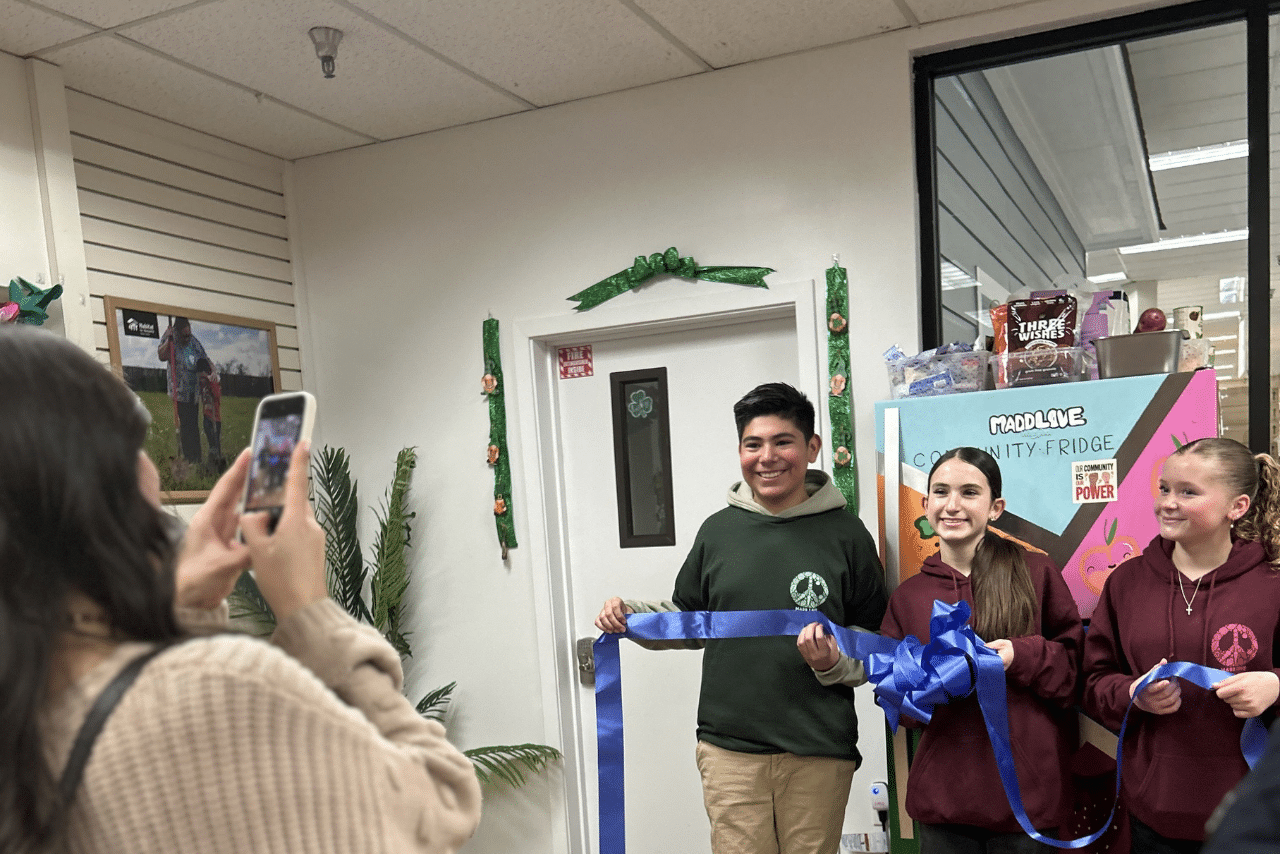
Currently, Addalie and Mia are using technology like Google Forms to collect data by tracking the food that’s going in and out. They also clean out the refrigerator weekly with their mothers. But eventually, there will be a need to build more formal infrastructure if the number of community refrigerators grows, potentially by establishing a new non-profit organization
“I think that’s another great role for Blue Zones Project– to really help them navigate building that infrastructure so that it is sustainable,” Sanders said.
“Our Blue Zones Project created a Food Policy Council for Yuba Sutter, and I think the council can really be an active partner in the work that they're doing.” -Marni Sanders Share on XHaving infrastructure in place helps set the stage for the community refrigerator project to transition to a nonprofit. “I’m really excited about it,” Sanders said. “Our Blue Zones Project created a Food Policy Council for Yuba Sutter, and I think the council can really be an active partner in the work that they’re doing. This council is intended to be sustainable and live beyond the Blue Zones Project as well, so I think it can be a really supportive arm to the work that the girls are doing because the council is trying to solve the food access issues and create a stronger food system within the Yuba Sutter community.”
“This council is intended to be sustainable and live beyond the Blue Zones Project as well, so I think it can be a really supportive arm to the work that the girls are doing because the council is trying to solve the food access issues… Share on XLisa Oliver Monroe is a journalist and author of a travel book about America’s Historic Triangle (Williamsburg, Jamestown, and Yorktown). Her writing has been published by Virginia Living, Boomer Magazine, Kirkus Media, Advance for Nurses, and Colonial Williamsburg, among many others.