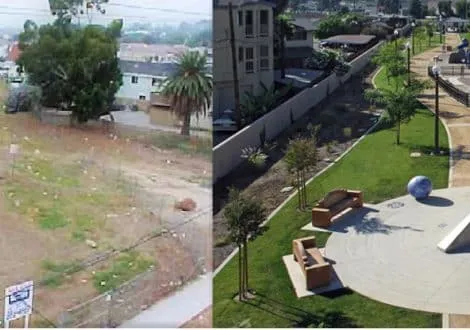
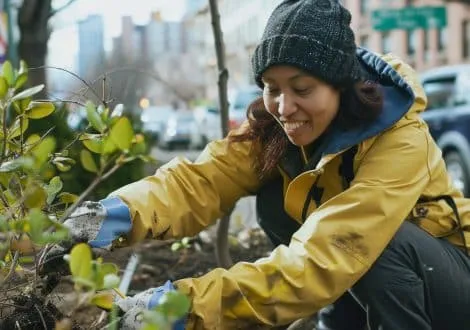
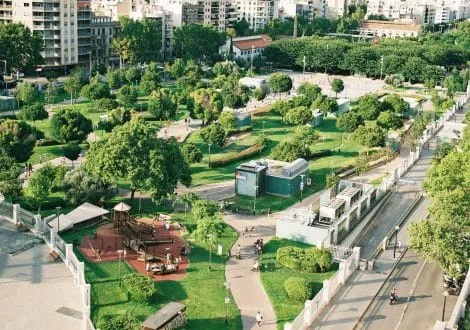
The built environment is a key social determinant of health that critically impacts one’s physical, mental, and social well-being. When discussing the built environment, we often think of public spaces such as parks, community gathering spots, downtown squares, and recreation facilities. These areas give people access to green space and places to exercise, as well as connect them with nature, encourage social cohesion, and create a sense of belonging.
The built environment is a key social determinant of health that critically impacts one’s physical, mental, and social well-being. Share on XPublic spaces often serve as what sociologists call “third spaces.” These are places outside of home, work, or school where people can relax, socialize, and participate in their communities. Unlike many other gathering spaces, public spaces are theoretically open to people of all ages, races, and socio-economic backgrounds. But historically, certain groups have faced barriers that keep them from fully utilizing public spaces. One group that has received little attention in this regard is teenagers.
[RELATED: The Importance of Third Spaces Amidst America’s Social Isolation Epidemic]

The Decline of Teen Third Spaces
For decades, teens have utilized common third spaces such as malls, roller rinks, and arcades. Many of these spaces, however, have been disappearing or severely declining in use over the past 20 years. After-school programs can help fill the gap, but they often serve only select interests, present barriers for some student demographics, or operate for only a fraction of the year. Most other common third spaces are off-limits to teens. Bars, restaurants, and cafes may have age and financial restrictions. Playgrounds may feel too childish. And some cultural norms and stereotypes sometimes discourage teens from hanging out in public spaces at all.
This leaves public spaces such as parks, libraries, community centers, and town squares as some of the only year-round, no-cost options for teens to utilize as their third space. Unfortunately, public space planning often overlooks this age group in the design of these spaces..
Barriers to Teen Inclusion in Public Spaces
Many public spaces and programs are designed with children, adults, or seniors in mind, but not teenagers. Teens have been identified as one of the least served populations during out-of-school hours, and they are sometimes intentionally excluded from public spaces.
Third places can be deeply political and contentious, with rules, regulations, and designs that can be used to both intentionally and unintentionally exclude teens. Intentionally, rules like curfews, skateboarding bans, or loitering ordinances can limit teen access to public spaces. Unintentionally, teens may be treated with suspicion and linked to vandalism, crime, or disruption. “Hanging out” with friends is an important activity for teens, but adults sometimes perceive this unstructured behavior as suspicious or undesirable. Teens themselves say many public spaces lack age-appropriate features that appear to exclude adolescents entirely. They see small swings, low slides, and basic playgrounds as designed for younger children only.
Health and Well-being Impacts
Teen health—mental, social, and physical—has been declining over the past decade. The COVID-19 pandemic rapidly exacerbated this trend. While the rise of personal technology and the use of social media have been linked to the decline in teen health, social isolation and lack of community support are also contributing factors, causing teens to turn away from their community and toward their screens.
Adolescent experiences in the built environment are important for their well-being through positive experiences of place attachment, belonging, security, escape, risk, adventure, exploration, curiosity, independence, and the right to roam freely. The most direct and comprehensive study related to adolescent access to third places and mental health found that adolescents who did not have a third place were two times more likely to develop low self-esteem, regardless of family factors such as poverty or school social capital. Public space and the built environment as a third space for teens are critically important for their overall well-being.
Public space and the built environment as a third space for teens are critically important for their overall well-being. Share on XHow Do We Make a Change?
So, how do we help our teens better utilize public spaces and reconnect with third spaces? Planners, government officials, designers, and developers must go out of our way to invite teens into the process. Holding focus groups or open houses at local middle and high schools, consulting student clubs or organizations, and specifically calling on teens to elicit feedback on public space development projects is the first step.
Instead of criticizing “hanging out” or screen time, we can design spaces that embrace these activities in positive ways. Teens often prefer flexible, open-ended opportunities over rigidly structured programs. They value spaces that respect their independence, allow for creativity, and encourage social connection. Providing unique and appealing sitting spaces, age-appropriate and size-appropriate play equipment, innovative uses of technology that encourage socialization, and open-ended experiences that promote free thinking are all methods that should be further researched and deployed.
Third spaces are essential for well-being, and they are disappearing for teens. Public spaces are one of the last remaining options, but they need to be designed with teenagers in mind. By actively including adolescents in the planning process, incorporating elements attractive to their age group, and challenging our biases, we can encourage teens to visit, be active, and feel connected to their communities. If we want healthier, more engaged young people who develop into engaged, active, connected adults, we must make public spaces into places where teens feel like they belong.
If we want healthier, more engaged young people who develop into engaged, active, connected adults, we must make public spaces into places where teens feel like they belong. Share on X