
Why Japanese Train Stations Just Feel Better
In some ways, the morning commute in Tokyo looks no different than it does in other megacities around the world. Weekday mornings see bustling streets, bumper-to-bumper traffic, well-dressed commuters carrying backpacks and briefcases, and jam-packed trains. These rush hour scenes are common from New York to London to Shanghai. However, several imperceptible features of the Japanese rail system make the Tokyo commute easier and less stressful to navigate than its international counterparts, contributing to the island nation’s long-held and well-deserved reputation for having the best train system in the world.
Japan’s extensive and accessible network of high-speed and urban rail trains moves over 9 billion passengers each year, with an on-time performance measured down to the second. In fact, the country’s primary passenger rail operator, Japan Railways, once issued a statement to apologize for a train departing 25 seconds early. To call this transit system reliable and efficient would be an understatement: Japan’s train system is a modern transportation marvel. And each individual train station plays a significant role in this broader industry reputation—particularly when it comes to nudging passengers into behaviors that promote well-being.
Nudge techniques are ways of influencing human behavior through subtle changes to the environment. They can have surprisingly meaningful impacts despite their imperceptibility, and they can be effective for making healthy choices easier and more routine across entire populations. In Japan, nudge techniques involving light, sound, and signaling have been used to design train stations for reduced stress and increased safety—two factors that can have a significant impact on passenger well-being.
In Japan, nudge techniques involving light, sound, and signaling have been used to design train stations for reduced stress and increased safety—two factors that can have a significant impact on passenger well-being. Share on XSoothing Sounds for Stress-Free Travel
In rail-reliant cities, the rush-hour commute can be chaotic and stressful, even for swift and savvy locals. Rushed footsteps, crowded escalators, conductor whistles, and the screeches of arriving and departing trains all contribute to heightened feelings of stress and fatigue among commuters. Beginning one’s day this way can take a toll on overall well-being, particularly when it becomes part of a daily routine.
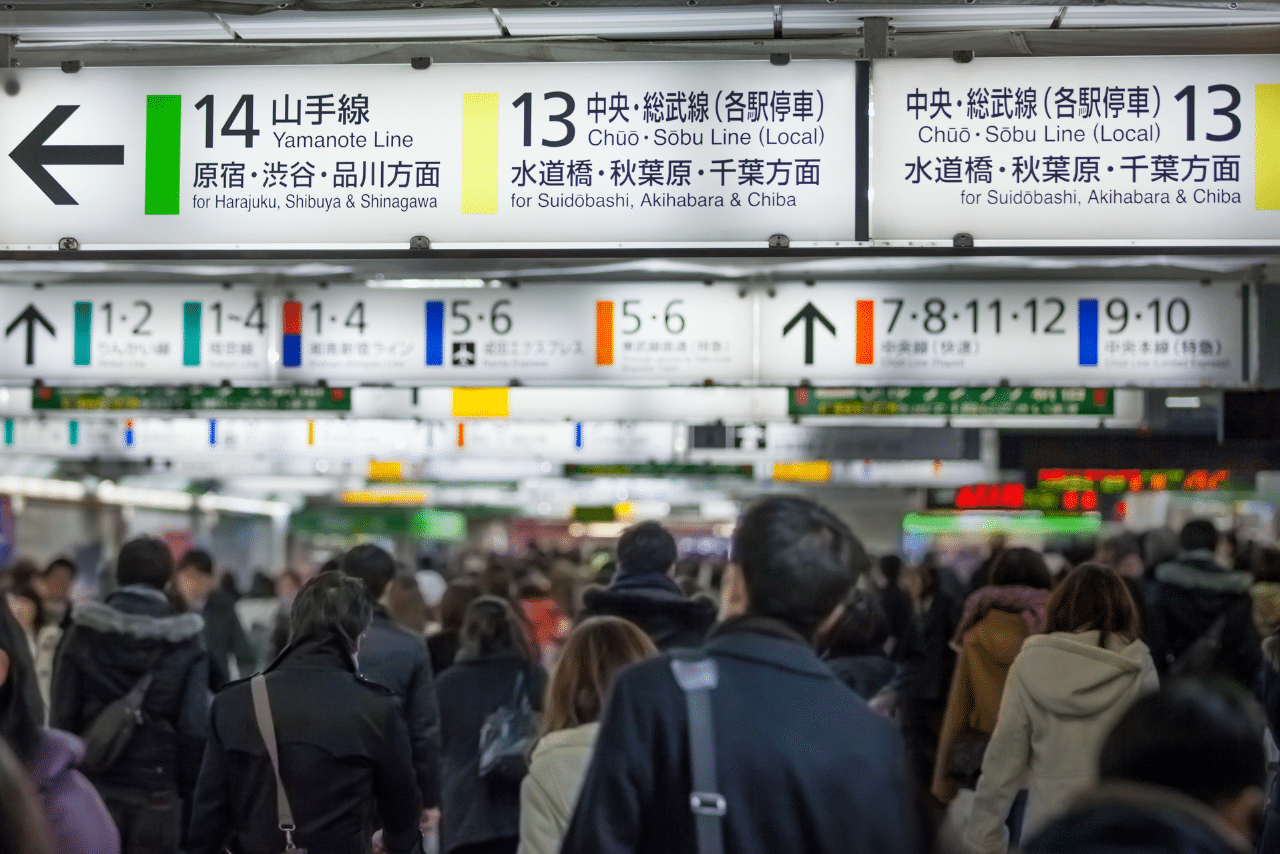
One of the features that sets Japan’s train stations apart is a simple sonic solution that quickly shifts the tone of the morning commute. Prior to 1989, stations used a harsh, blaring buzzer to signal every train’s departure. In an effort to reduce the high-stress nature of the morning commute, JR East (one of the country’s largest rail operators) commissioned Yamaha and sound designer Hiroaki Ide to create a collection of hassha melodies—pleasing, playful jingles that harmoniously blend into each station’s environment—to replace the departure buzzer. They are designed to jolt passengers into action without causing additional anxiety.
One of the features that sets Japan’s train stations apart is a simple sonic solution that quickly shifts the tone of the morning commute. Share on XEach hassha tune is short (about seven seconds), playing as long as a train’s doors remain open. This can provide some comfort to those in a hurry, helping passengers gauge how soon a train will depart based on which part of the jingle is playing. Nearly every station has its own departure melody, some of which are based on music from cartoons and films in Japanese popular culture, contributing to each station’s identity.
@journalonthego Door-closing chimes at the Tokyo metro stations are something else. We all know that commuting is stressful, especially when trying to catch a train at the last moment. Having these pleasing, seven-second-long chimes known as hassha melodies to warn passengers when the train doors are closing I guess is normal for Japanese people. I found them really fun and I was waiting every time at a different station to see what the chime is going to be like. What so you think of Tokyo’s metro? #tokyo #tokyometro #tokyotrainstation #japan #japanese #travel #travelreels #travelasia #fyp #fypシ ♬ original sound – Jurnal în Deplasare ✈️
Decades after their introduction, a 2008 study at Tokyo Station found a 25% reduction in the number of passenger injuries due to rushing as a result of the use of hassha melodies on select platforms. Beyond decreasing passenger stress and injuries, these tunes have made the nation’s train stations into uniquely enjoyable cultural mainstays, bringing joy to a typically stressful part of daily life.
Decades after their introduction, a 2008 study at Tokyo Station found a 25% reduction in the number of passenger injuries due to rushing as a result of the use of hassha melodies on select platforms. Share on XCalming Colors
While Japanese rail is renowned for its punctuality, reliability, and cleanliness, it is unfortunately also known for a tragic phenomenon. Japan has one of the highest suicide rates among OECD nations, and it is common for those seeking to take their own lives to leap off platforms in front of oncoming trains. These instances can cause significant transit delays, and they can be distressing for both passengers and transit workers.
To address the issue, train stations across Japan have installed chest-high platform barriers, both to prevent suicides and to prevent people from accidentally falling off platforms and onto the tracks. While these barriers have proven highly effective in reducing suicides, they can be expensive and difficult to install. Some stations are taking alternative or additional precautions to prevent rail suicides through the use of mood-enhancing lights.

Blue wavelengths of light have been shown to elevate mood and boost alertness. And as it turns out, blue LED lamps are less expensive to install around train stations than platform barriers. In 2009, several stations across Tokyo added several small, square LED lamps onto platforms. Emitting a calming, blue glow, the lamps are hardly noticeable to those who don’t know to look for them. They are strategically placed in the least trafficked parts of train platforms, where jumps often occur.
Blue wavelengths of light have been shown to elevate mood and boost alertness. And as it turns out, blue LED lamps are less expensive to install around train stations than platform barriers. Share on XSince their adoption, blue LED lamps have also proven effective in preventing rail suicides. A 2013 study conducted by researchers at the University of Tokyo, analyzing 10 years of data across 71 Japanese stations, found an 84% decline in the number of suicide attempts at stations where blue LED lamps have been installed. However, the blue light solution is not a universal fix—subsequent studies have shown that blue lights are not always as effective during the day versus at night. Platform barriers remain the top solution recommendation among experts, but blue lights serve as a cost-effective alternative or supplement to platform barriers as needed.
The blue light method’s success within Japanese rail’s larger suicide-prevention strategy, coupled with its simplicity and low cost, has led to its expansion to train systems around the world—including in Scotland, England, New York, Belgium, and the Netherlands.
The blue light method’s success within Japanese rail’s larger suicide-prevention strategy, coupled with its simplicity and low cost, has led to its expansion to train systems around the world—including in Scotland, England, New York,… Share on XMindful Movements
A system that still remains largely confined to Japanese train stations is the pointing-and-calling method among rail workers, known in Japanese as shisa kanko. Slightly more noticeable than blue light lamps and hassha tunes, shisa kanko is the reason white-gloved rail workers are often seen pointing and calling aloud on platforms (even when no one appears to be listening) as trains arrive and depart.
A system that still remains largely confined to Japanese train stations is the pointing-and-calling method among rail workers, known in Japanese as shisa kanko. Share on XThis occupational safety measure works to raise rail workers’ consciousness while performing a task by associating the task with small physical movements and spoken words. Instead of relying solely on habit and muscle memory, every step of a worker’s task (such as a safety check on a train platform) is reinforced with physical movement and vocalization. According to research conducted by Japan Railways, this simple method is remarkably effective—it has been proven to reduce human error by nearly 85%.
@kayjonatravels Shinkansen departure /japan station /driver making sure everything is in control. #foryou #trains #shinkansen #japan #えき #金沢 #日本語 #kayjonatravels ♬ original sound – Kayjonatravels
At Japanese train stations, conductors and attendants are trained to perform all of their tasks using shisa kanko. When a train is about to depart, a conductor or attendant will point along the platform, at no one in particular, and declare an “all clear” to confirm that all passengers and their bags are on board and that the train is ready to depart. When conductors are performing a speed check, they point at their odometer and call out their speed to confirm that it’s correct, despite the fact that no one else is in the car to hear or see them.
At Japanese train stations, conductors and attendants are trained to perform all of their tasks using shisa kanko. Share on X
Shisa kanko has become a mainstay of the Japanese rail system since its adoption, contributing to the nation’s reputation for efficient, reliable, and lower-stress transit. But despite the pointing-and-calling method’s effectiveness, it remains largely limited to the Japanese rail system. However, New York City’s MTA subway system has successfully adopted its own modified, point-only system among conductors since 1996, inspired by Japan’s point-and-call system.
Shisa kanko has become a mainstay of the Japanese rail system since its adoption, contributing to the nation’s reputation for efficient, reliable, and lower-stress transit. Share on X
When it comes to nudging passengers and workers toward safety and well-being, the Japanese rail system stands in a league of its own. From cheery departure melodies to mood lighting and mindful movements, the island nation takes the benefits of public transportation several steps further by making it a less stressful, more pleasant experience for everyone who sets foot on a train in Japan.
From cheery departure melodies to mood lighting and mindful movements, the island nation takes the benefits of public transportation several steps further by making it a less stressful, more pleasant experience for everyone who sets foot… Share on XSophia Piña-McMahon is an Editorial and Digital Specialist at Blue Zones. She is a multimedia journalist and digital marketing professional who specializes in stories at the nexus of food, culture, public health, and the environment. Sophia’s work has previously been published in Lonely Planet, the Mad Agriculture Journal, and local news outlets. She holds a Master of the Environment in Sustainable Food Systems from the University of Colorado Boulder and a Bachelor of Science in Anthropology and Geography from Cal Poly San Luis Obispo.
Related Articles
-

Blue zones residents move naturally every day simply because their environments nudge them to do…
-

Okinawa, Japan, has one of the highest life expectancy rates in the world. How does…
-

By Leo Babauta, Founder of Zen Habits and the author of The Power of Less…
-

Excerpted from The Blue Zones Solution by Dan Buettner, published 7 April, 2015. It took…